For years, conversations about Southern Baptist cooperation have been at the forefront of the Southern Baptist conversation. Who are we 'disfellowship-ing' or not? Does our process work? The Credentials Committee has been right at the heart of that discussion—not as a participant, but as a subject. As the Credentials Committee and the process related to Bylaw 8 have been discussed, the Committee itself has quietly carried out its work, mostly heard from only at the Annual Meeting, apart from their executive session reports to the SBC Executive Committee.
That is why we are grateful for the conversation below. A while back we asked Jonathan Sams, Chairman of the Credentials Committee of the Southern Baptist Convention, if he would do a written interview with us related to the committee, their work, and what Southern Baptists can expect to hear from them at this year's annual meeting. You can read that full conversation below. Our hope is that you find it informative and helpful as you consider all of the issues ahead related to cooperation, the credentials process, and even related issues.
TBR: Let's get started with a foundational question: What is the Credentials Committee, and what is it not?
Sams: The Credentials Committee reviews concerns about whether a church is in friendly cooperation with the Southern Baptist Convention under Article III of the SBC Constitution. It evaluates the information presented and forms an opinion or recommendation to assist the Executive Committee and, if needed, the Convention. Consistent with Article IV of the SBC Constitution, the Committee does not exercise authority over any church. The Convention recognizes that each church is independent and sovereign in its own sphere, and the Committee’s role is not to govern churches or supervise church operations. Its role is limited to helping the Convention consider whether a church’s relationship with the Convention remains consistent with the standards for friendly cooperation.
TBR: When the Committee receives a submission about a church, what happens next? Walk readers through the process from initial referral to possible recommendation.
Sams: When the Credentials Committee receives a submission or referral concerning a church, the matter is placed before the Committee for initial review. The committee typically meets about 8-10 times each year. During each meeting the committee considers any concerns that have been raised since the last meeting and determines the next step. It may decline to take up the matter, seek additional information, including seeking information directly with the church in question. If the Committee continues its review, it may gather and consider relevant information before deciding whether to form an opinion that a church should be considered not in friendly cooperation with the Convention. Throughout the process, the Committee’s role is limited to assisting the Executive Committee and, if needed, the Convention; it does not exercise authority over the church or govern the church’s internal affairs.
TBR: What sources of authority guide the Committee most: the Constitution, Bylaws, Baptist Faith and Message, messenger votes, resolutions, or prior committee decisions?
Sams: While the bylaws outline the committee's composition and role, the Constitution, BF&M and messenger votes are the primary sources of authority since they are linked. The Constitution instructs that only a church that closely identifies with the Convention’s adopted statement of faith (BF&M 2000) will be deemed to be in friendly cooperation. Those two documents are inseparable. Messenger votes help provide clarity on what the Convention considers to be close identity. Resolutions also play a guiding role. Southern Baptists have always considered resolutions to be non-binding and reflect the Convention’s opinion at a given time. Since the Convention has tasked the Credentials Committee, a standing committee of the Convention, specifically with “forming an opinion,” it makes sense that the committee should avoid forming an opinion contrary to the most recently expressed opinion of the Convention.
TBR: Does the Committee focus on title, office, authority, preaching function, ordination, or some combination?
Sams: The committee primarily considers a combination of office, function of oversight & preaching, and the church’s confessional identity, while strongly urging churches to rightly apply the title of pastor/elder/overseer only to qualified men.
TBR: I’m sure you know that there are accounts online that post about churches that they think are in violation of our faith and practice. Is the Credentials Committee able to proactively pursue those questions?
Sams: No. The Credentials Committee has no investigative authority under SBC Bylaw 8. Therefore, the committee only considers concerns that are submitted to it.
TBR: What is the general understanding of the Committee of what it means for a church to “closely identify” with the Convention in faith and practice?
Sams: The Committee generally understands “closely identify” to mean that a cooperating church’s stated faith and actual practice should be substantially consistent with the Convention’s adopted statement of faith, The Baptist Faith and Message 2000. Article III does not require a church to be identical to every other Southern Baptist church in every matter of local practice, nor does it authorize the Convention or the Committee to govern the church. Rather, it asks whether the church’s faith and practice remain sufficiently aligned with the doctrinal and cooperative standards the Convention has adopted for churches in friendly cooperation. The SBC Constitution identifies this as one of the standards for a cooperating church and gives examples of conduct that would place a church outside being in friendly cooperation in Article III.
TBR: How does the Committee ensure due process for churches that are referred?
Sams: The committee recognizes that neither it nor the Convention has any authority over a church or any other autonomous Baptist body. This is clearly expressed in Article IV of the SBC Constitution. However, the Convention, autonomous in its own sphere, can decide for itself the churches with which it will cooperate, and it has tasked the Credentials Committee with forming an opinion regarding a church for which a concern has been raised.
When the Committee determines that inquiry is needed and once the inquiry is complete, the Committee may either recommend the church to the EC or Convention as not being in friendly cooperation, or close the inquiry without recommendation. If the submitter of the concern disagrees with the Committee’s opinion, they can request reconsideration and provide additional information that may change the Committee’s opinion, or they may make a motion during the annual meeting that the church not be considered to be in friendly cooperation.
When a motion is made during the annual meeting, the Committee, when prepared, makes a recommendation to the Convention or, if not prepared at that annual meeting, will consider the matter in the same manner as those concerns received between sessions. For those cases, the Committee will make a recommendation to the EC (either in September or February, if they form the opinion that the church should not be considered in friendly cooperation) or directly to the Convention when it meets in June.
When the Committee receives a concern and determines that an inquiry is needed they may inquire of a church, which is essentially opening a dialogue between the Committee and the church. The goal is resolution and maintaining cooperation. It is only when the Committee and a church reach an impasse that the Committee may make a recommendation to the Executive Committee or to the Convention that a church is not in friendly cooperation. The Committee views making such a recommendation to discontinue the relationship as a last resort. The Committee often works with a church for several months before forming an opinion, especially when a church demonstrates a spirit of cooperation and a willingness to address the concern raised regarding its relationship with the Convention. Again, it is only when the Committee reaches an impasse with a church or the church refuses to respond, demonstrating a lack of intent to cooperate, that the Committee moves forward with a recommendation.
TBR: Could you give us just some statistics so that we can understand the scope of your work? How many reports have been made to the Credentials Committee? How many of those have been related to women in ministry?
Sams: The committee plans to give a statistical report with this information to the Convention next week at the 2026 annual meeting.
TBR: For the Credentials Committee, are messenger actions “precedent-establishing” unless otherwise changed by the messenger body in some formal way?
Sams: Prior messenger actions are important guidance for the Committee, and the Committee considers prior actions of the Convention when forming opinions about later submissions involving similar facts or issues. However, each concern is reviewed on its own facts.
TBR: The Committee on Resolutions just released their proposed resolutions for the Convention earlier this week, and one deals with the office of pastor and relatedly the issue of women pastors. Do you expect that resolution, if passed in its current state, to inform the work of the Credentials Committee? If so, how?
Sams: Because resolutions must be submitted by an individual messenger, I submitted the resolution in my capacity as chair and on behalf of the Credentials Committee. Once submitted, that language belongs to the Resolutions Committee’s process; that committee may accept, reject, revise, combine, or replace it. I would want to distinguish between the language submitted for consideration and the resolution ultimately reported, while also recognizing that the reported resolution remains consistent with the convictions reflected in the Committee’s submission and the Convention’s confession. If adopted, the final resolution would be the Convention’s resolution and would reflect the messengers’ opinion. That expressed opinion can help the Credentials Committee better understand recurring questions regarding cooperation and close identity without requiring the Convention to amend its governing documents, while remaining consistent with the Constitution, Bylaws, and Baptist Faith and Message.
TBR: Some have complained about the lack of transparency from the Credentials Committee. Why doesn’t the Credentials Committee offer more transparency on its standards, its decision-making process, and its correspondence with churches that choose to withdraw?
Sams: It is not the Credentials Committee’s role or responsibility to create standards for cooperation for churches. It is rightly the responsibility of the Convention to determine the standards by which it will deem a church to be in friendly cooperation. It is the Committee’s assignment to form an opinion about whether a church closely identifies with the standards set by the Convention.
The Committee has on numerous occasions discussed its process for considering concerns raised. When a concern is received, the Committee may inquire, decline, or request more information. The inquiry process opens a dialogue with the church in question in order to help the Committee form an opinion about whether the church should be considered a church in friendly cooperation with the Convention. When an inquiry is complete, the Committee makes a recommendation to the EC (or in some cases the Convention) if its opinion is that the church should no longer be considered a church in friendly cooperation with the Convention. The Committee may also form the opinion that the church is in friendly cooperation, at which time the inquiry is closed without recommendation.
If the submitter of a concern is not satisfied with the Committee’s opinion that a church should be considered in friendly cooperation, the submitter may request reconsideration and supply additional information. The matter of a church’s cooperation may also be raised on the floor of the annual meeting, and the Committee will either report back to the Convention when prepared or recommend to the EC between annual meetings that the church should not be considered a church in friendly cooperation.
Because the Convention’s relationship with any church is entirely cooperative, a church’s decision to voluntarily withdraw its relationship is not the Credentials Committee’s decision. It is the church’s decision. However, an update is provided to the person(s) who reported the concern for consideration. The committee intends to provide an annual statistical report to the Convention beginning this year.
TBR: Has the Credentials Committee made any decisions in the past that it feels were a mistake, and which have led it to directly consider changes to its process?
Sams: The Committee has, from time to time, reviewed its past work and considered whether its processes should be clarified or improved. Like any committee carrying out a responsibility on behalf of the Convention, the Credentials Committee seeks to learn from prior matters and to handle future submissions with greater consistency, care, and clarity, and the Committee has evaluated its procedures in light of experience.
TBR: What changes, if any, would help the Committee do its work with greater clarity, fairness, and trust? Is there anything you wish the SBC would offer to aid you in your work?
Sams: The Committee would benefit from the Convention giving clearer guidance on recurring issues that arise in its work. A resolution would help the Committee evaluate concerns with greater clarity. Such guidance would not replace the SBC Constitution, Bylaws, or The Baptist Faith and Message, but it would help the Committee better understand and apply the Convention’s expressed judgment.
TBR: Jonathan, thank you for your time and for this conversation. We recognize you've given an enormous amount of your time—as well as your committee members—to serve Southern Baptists on these hard questions. We appreciate it, and appreciate your answers here.
Sams: Thanks for the opportunity. We are grateful to serve Southern Baptists.
-----
Register now for the 2026 Presidential Forum

Griffin Gulledge
Griffin Gulledge is pastor of Fayetteville First Baptist Church in Fayetteville, GA. He is married to Rachel. Together they have two children. Griffin is a graduate of Auburn University (B.A.) and Samford University's Beeson Divinity School (M.Div.). He is currently completing his Ph.D. at Southeastern Baptist Theological Seminary in systematic theology. Previously, he served as Director of Marketing and Communications at SEBTS, moderator of his local association, and as a member of the GBMB Executive Committee. In 2021, he was recipient of the John Leland Religious Liberty Award. He is a founder and member of the leadership team for The Baptist Review.

Rob Collingsworth
Rob Collingsworth works as Director of Strategic Relationships for Criswell College and has also worked as a writer and editor for the Southern Baptist Texan. He served on the SBC Resolutions Committee in 2023 and 2024, and also served two terms on the SBTC's Ethics and Religious Liberty Committee. Rob previously worked at Samford University, where he received his B.A. in Journalism, and at Southwestern Seminary, where he earned an M.Div. with an emphasis in ethics. He and his wife Rebeccah live in Fort Worth and have four children. In addition to leading the editorial efforts, Rob is a founder and leadership team member for The Baptist Review.

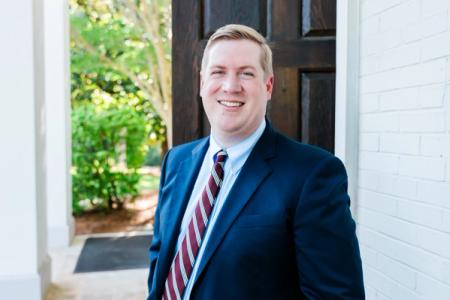
Jonathan Sams
Jonathan Sams serves as an elder at Image Church in Marietta, Georgia. He is pursuing a PhD in applied theology, and he works in the technology sector. Jonathan is the current chairman of the Southern Baptist Convention's Credentials Committee (2025-2026).